 Skip to content
Choosing professional CCTV Installation for Clinics in Mohandessin is one of the most effective ways to protect patients, medical staff, expensive equipment, and confidential healthcare operations. Clinics located in Mohandessin experience continuous patient traffic throughout the day, making surveillance systems an essential part of modern healthcare security. A properly designed CCTV solution not only deters theft and unauthorized access but also helps clinic owners monitor daily operations, improve employee accountability, and respond quickly to incidents.
Unlike retail stores or office buildings, medical clinics require surveillance systems that balance security with patient privacy. Every camera must be positioned strategically to monitor public areas without compromising confidential examinations or violating privacy expectations. This is why working with an experienced installer familiar with healthcare environments is essential.
Why Clinics in Mohandessin Require Professional CCTV Systems
Mohandessin is one of the busiest commercial and medical districts in Giza, attracting patients from neighboring areas such as Dokki, Agouza, Zamalek, Downtown Cairo, and 6th of October City. The constant flow of visitors increases security challenges that cannot be addressed through basic security measures alone.
Professional CCTV Installation for Clinics in Mohandessin helps healthcare providers reduce operational risks while creating a safer environment for both patients and employees. High-definition surveillance cameras capture clear footage around entrances, reception areas, waiting rooms, pharmacies, and parking spaces, allowing clinic managers to review events whenever necessary.
Beyond preventing theft, surveillance systems support smoother clinic management by identifying bottlenecks in patient flow, monitoring visitor activity, and helping staff respond more efficiently during busy periods.
Benefits of Installing CCTV in Medical Clinics
Healthcare facilities operate differently from most commercial properties because they store valuable medical devices, prescription medications, and confidential patient records. A professionally designed surveillance system addresses these unique challenges through continuous monitoring and intelligent security features.
The most important benefits include:
Improved patient safety through continuous monitoring of public areas.
Protection against equipment theft and vandalism.
Better oversight of reception and administrative operations.
Evidence collection in case of disputes or security incidents.
Improved employee accountability and operational transparency.
Enhanced visitor management throughout the clinic.
Remote access for clinic owners using secure mobile applications.
Support for insurance claims through recorded video evidence.
Modern IP surveillance systems also integrate with access control solutions, allowing administrators to monitor both video footage and building access from a centralized management platform.
Best Locations to Install CCTV Cameras Inside a Clinic
Effective surveillance depends more on camera placement than on the total number of cameras installed. Each location should address a specific security objective while maintaining patient privacy.
Reception Area
Reception is the busiest location in most healthcare facilities. Cameras installed here monitor visitor arrivals, appointment interactions, payment transactions, and administrative activities. High-resolution cameras help document incidents without interfering with daily operations.
Clinic Entrance
The main entrance should always be covered by wide-angle surveillance cameras capable of capturing facial details and visitor movement. This footage provides valuable evidence if unauthorized access or suspicious activity occurs.
Waiting Areas
Waiting rooms often experience the highest concentration of patients and visitors. Installing surveillance cameras helps resolve disputes, monitor overcrowding, and improve overall safety without recording private medical consultations.
Hallways and Corridors
Corridors connect different treatment rooms and departments. Cameras positioned along these pathways improve visibility while helping staff identify unauthorized movement within the facility.
Pharmacy and Medication Storage
Prescription medications represent one of the highest-value assets inside healthcare facilities. Surveillance cameras discourage internal theft, monitor inventory access, and support compliance with internal security policies.
Medical Equipment Rooms
Diagnostic machines, laboratory equipment, and specialized medical devices require additional protection. Surveillance cameras provide continuous monitoring and help reduce the risk of unauthorized handling or theft.
Parking Areas
Clinics with private parking facilities benefit from outdoor surveillance cameras equipped with weather-resistant housings, infrared night vision, and wide dynamic range technology. Monitoring vehicle movement improves security for both patients and employees.
Building Exits
Emergency exits and secondary doors should never become security blind spots. Cameras covering these locations help detect unauthorized access attempts and support emergency investigations when required.
Choosing the Right CCTV System for Medical Clinics
Selecting the appropriate surveillance solution depends on the clinic’s size, layout, operating hours, and security objectives. A small specialist clinic may only require a limited number of cameras, while a multi-floor medical center needs a fully integrated surveillance network capable of monitoring several departments simultaneously.
Professional CCTV Installation for Clinics in Mohandessin should begin with a detailed site survey to identify vulnerable areas, lighting conditions, network infrastructure, and future expansion requirements. This assessment ensures that every camera serves a specific purpose instead of creating unnecessary costs.
Modern surveillance systems can also be scaled as the clinic grows. Additional cameras, storage capacity, and advanced analytics can be integrated without replacing the entire security infrastructure, making IP-based systems a long-term investment.
IP Cameras vs Analog CCTV Systems
Many clinic owners ask whether they should choose traditional analog cameras or modern IP surveillance systems. While both provide video monitoring, IP technology offers significant advantages for healthcare facilities.
| Feature | IP Cameras | Analog Cameras |
|---|---|---|
| Video Quality | Ultra HD and 4K | Standard HD |
| Remote Access | Yes | Limited |
| AI Features | Available | Very Limited |
| Scalability | Excellent | Moderate |
| Network Integration | Full | Limited |
| Storage Options | NVR, Cloud, Hybrid | DVR |
| Long-Term Flexibility | High | Lower |
For most healthcare facilities, IP surveillance systems provide better image quality, easier management, and greater flexibility for future upgrades.
Recommended Camera Types for Clinics
Different areas require different camera designs to achieve optimal coverage.
Dome Cameras
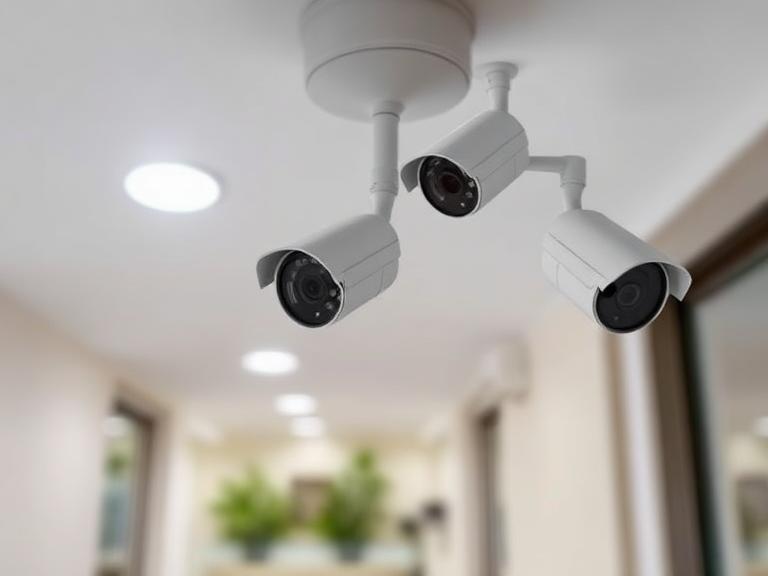
Dome cameras are commonly installed in reception areas, waiting rooms, and hallways because of their discreet appearance and wide viewing angles. Their vandal-resistant design makes them suitable for public spaces.
Bullet Cameras
Bullet cameras are ideal for outdoor entrances, parking lots, and building perimeters. Their long-range lenses provide clear identification over greater distances.
Turret Cameras
Turret cameras offer excellent low-light performance and are frequently used in clinics where image clarity is essential under varying lighting conditions.
PTZ Cameras
Pan-Tilt-Zoom cameras allow security personnel to remotely control viewing direction and zoom levels. These cameras are typically recommended for larger medical centers rather than small private clinics.
AI-Powered Surveillance for Modern Healthcare Facilities
Artificial intelligence has transformed the capabilities of modern CCTV systems. Instead of simply recording video, today’s surveillance platforms can identify unusual activity and notify administrators immediately.
Advanced CCTV Installation for Clinics in Mohandessin often includes intelligent video analytics that improve both security and operational efficiency.
Popular AI features include:
People counting for managing patient flow.
Intrusion detection outside operating hours.
Line crossing alerts at restricted areas.
Object removal and abandoned object detection.
Facial recognition where legally appropriate.
Vehicle detection for clinic parking areas.
Behavior analysis to identify unusual activity.
These intelligent features reduce the need for continuous manual monitoring while improving incident response times.
Camera Placement Best Practices
Proper camera positioning is essential for obtaining useful footage.
Install cameras at heights that minimize tampering while maintaining clear facial identification.
Avoid directing cameras toward examination rooms or treatment areas where patient privacy must be protected.
Reduce glare by considering windows and lighting during installation.
Ensure overlapping coverage at entrances and exits to eliminate blind spots.
Use infrared cameras for outdoor locations that require nighttime surveillance.
Maintain clear fields of view by avoiding decorative objects, signs, or equipment that may obstruct the image.
Label surveillance zones where required by applicable regulations and clinic policies.
Professional installers perform coverage testing before completing the project to verify that every important area is visible under both daytime and nighttime conditions.
Integrating CCTV with Access Control Systems
Many clinics benefit from combining surveillance cameras with electronic access control. This integration allows administrators to verify who entered restricted areas while reviewing synchronized video footage.
Commonly secured areas include:
Pharmacies.
Medical supply storage.
Laboratories.
Administrative offices.
Server rooms.
Staff-only entrances.
Medication storage facilities.
When access events are linked with recorded video, investigations become significantly faster and more accurate.
Remote Monitoring and Mobile Access
Clinic owners are not always on-site, making remote monitoring an essential feature of modern surveillance systems. Secure mobile applications allow authorized users to view live footage, receive instant alerts, and review recordings from virtually anywhere.
With professional CCTV Installation for Clinics in Mohandessin, remote management enables administrators to:
Monitor daily clinic operations.
Verify alarm notifications.
Check patient traffic during business hours.
Review recorded incidents.
Manage multiple clinic branches from one platform.
Share video clips securely with authorized personnel when necessary.
Encrypted connections and role-based user permissions help protect sensitive surveillance data from unauthorized access while ensuring that only approved individuals can view or manage the system.
CCTV Storage Solutions and Recording Options
A reliable surveillance system is only as effective as its ability to store and retrieve footage when needed. During a professional CCTV Installation for Clinics in Mohandessin, storage capacity should be calculated based on the number of cameras, recording resolution, frame rate, retention period, and whether cameras record continuously or only when motion is detected.
Most healthcare facilities choose one of the following storage options:
Network Video Recorder (NVR): The preferred solution for IP camera systems, offering high-resolution recording, centralized management, and easy scalability.
Cloud Storage: Suitable for clinics that want secure off-site backups and remote access without relying solely on local hardware.
Hybrid Storage: Combines local NVR recording with encrypted cloud backup, providing additional protection if on-site equipment is damaged or stolen.
For many clinics, retaining video recordings for 30 to 90 days provides a practical balance between storage costs and operational needs. However, retention policies should always align with organizational requirements and any applicable legal obligations.
Cybersecurity for IP Surveillance Systems
As CCTV systems become connected to clinic networks, cybersecurity becomes just as important as physical security. An improperly configured camera network can expose sensitive systems to unnecessary risks.
To improve security, professional installers should:
Change all default usernames and passwords.
Enable strong password policies.
Use encrypted remote access whenever available.
Keep camera firmware updated.
Place surveillance devices on a separate network segment from medical systems.
Restrict administrator access to authorized personnel only.
Enable activity logs for system changes and login attempts.
Working with experienced installers helps ensure that surveillance equipment is configured according to current security best practices rather than factory default settings.
Legal and Privacy Considerations for Healthcare Facilities
Healthcare providers have a responsibility to balance security with patient privacy. Surveillance cameras should enhance safety without recording areas where patients have a reasonable expectation of privacy.
As a general best practice, cameras should monitor public and operational spaces such as:
Reception areas.
Waiting rooms.
Building entrances and exits.
Parking areas.
Administrative offices.
Hallways.
Storage rooms.
Pharmacies.
Cameras should not be installed in examination rooms, treatment rooms, restrooms, or other sensitive locations unless there is a clear legal basis and all applicable regulations are followed.
Visible signage informing visitors that surveillance is in operation also promotes transparency and can act as an additional deterrent against theft or misconduct.
Common CCTV Installation Mistakes
Many security issues arise not because cameras are unavailable, but because the system was poorly designed or installed.
Common mistakes include:
Choosing cameras based only on price.
Installing too few cameras to cover critical areas.
Creating blind spots at entrances and exits.
Using insufficient storage capacity.
Ignoring future expansion needs.
Failing to secure the surveillance network.
Neglecting routine maintenance.
Using low-quality cables or networking equipment.
Improper camera angles that reduce facial identification.
Lack of adequate lighting for nighttime recording.
Avoiding these mistakes helps maximize the return on investment while ensuring the surveillance system performs reliably for years.
CCTV Maintenance Best Practices
Even the most advanced surveillance system requires regular maintenance to maintain image quality and operational reliability.
A preventive maintenance schedule should include:
Cleaning camera lenses.
Inspecting mounting brackets.
Testing recording functionality.
Verifying remote access.
Reviewing storage capacity.
Updating firmware.
Checking network performance.
Testing backup power systems.
Inspecting cables and connectors.
Confirming that timestamps and recording schedules remain accurate.
Routine maintenance reduces unexpected failures and extends the lifespan of the entire surveillance system.
Factors That Affect CCTV Installation Costs
The cost of CCTV Installation for Clinics in Mohandessin varies depending on several technical and operational factors rather than simply the number of cameras.
Key pricing factors include:
Clinic size and building layout.
Number of surveillance cameras.
Indoor and outdoor coverage requirements.
Camera resolution.
AI analytics features.
Storage capacity.
Network infrastructure.
Cable installation complexity.
Remote monitoring requirements.
Access control integration.
Cloud recording services.
Maintenance agreements.
Although lower-cost systems may appear attractive initially, investing in higher-quality equipment often reduces maintenance costs and provides better long-term performance.
How to Choose Egypt Techno Trade?
Selecting the right installer is just as important as choosing the equipment itself. A qualified provider should begin with a site inspection and recommend a solution tailored to the clinic’s operational requirements rather than offering a one-size-fits-all package.
Before hiring a company, consider the following:
Experience with medical clinics and healthcare facilities.
Knowledge of modern IP surveillance technologies.
Ability to design scalable security systems.
Availability of maintenance and technical support.
Quality of equipment from reputable manufacturers.
Transparent quotations with no hidden costs.
Professional installation standards.
Training for clinic staff on system operation.
Warranty coverage for equipment and installation.
Positive customer reviews and completed projects.
A reliable installer will explain the reasoning behind every recommendation, ensuring that the surveillance system meets current needs while allowing room for future expansion.
Why Local Experience Matters in Mohandessin
Working with a company that understands the local environment offers significant advantages beyond installing cameras. Clinics in Mohandessin often operate in mixed-use buildings with shared entrances, limited parking, varying internet infrastructure, and high pedestrian traffic. These factors influence camera placement, network design, and ongoing system maintenance.
A local installer can conduct a detailed site assessment, identify potential blind spots, and recommend equipment that performs well in the area’s environmental conditions. Faster response times for maintenance and emergency repairs also minimize downtime, ensuring that the surveillance system remains operational when it is needed most.
For clinics planning future expansion into nearby districts such as Dokki, Agouza, Zamalek, or Sheikh Zayed, selecting a scalable solution from the beginning helps maintain consistent security standards across multiple locations.
Supporting Other Security Systems
A modern clinic benefits from an integrated security strategy rather than relying solely on CCTV cameras. Combining surveillance with complementary technologies creates a safer and more efficient environment for staff and patients.
These systems work particularly well alongside CCTV:
Access control systems for staff-only areas.
Video intercom systems at entrances.
Intrusion alarm systems for after-hours protection.
Fire alarm integration for emergency response.
Visitor management systems for larger medical centers.
Emergency backup power supplies to maintain recording during outages.
When these technologies communicate with one another, clinic managers gain better visibility and faster incident response while reducing the need for manual intervention.
Signs That Your Clinic Needs a CCTV Upgrade
Many clinics continue using surveillance equipment that no longer meets modern security requirements. Upgrading the system can improve image quality, reliability, and overall operational efficiency.
Consider replacing your existing system if you experience any of the following:
Poor video quality that makes identification difficult.
Frequent recording interruptions.
Limited storage capacity.
No remote viewing capability.
Lack of mobile application support.
Frequent equipment failures.
Inability to expand with additional cameras.
Poor nighttime performance.
No intelligent analytics or motion detection.
Outdated DVR hardware that cannot support newer technologies.
An upgraded IP surveillance system can provide clearer footage, faster searches, better cybersecurity, and lower maintenance requirements over the long term.
Areas Served Around Mohandessin
Professional CCTV installation services are commonly available for clinics throughout Mohandessin and neighboring healthcare districts, making it easier for medical practices with multiple branches to maintain consistent security standards.
Common service areas include:
Mohandessin
Dokki
Agouza
Giza
Zamalek
Downtown Cairo
6th of October City
Sheikh Zayed
Smart Village
Haram
Faisal
Whether operating a single private practice or managing multiple clinics across Giza, implementing standardized surveillance systems simplifies administration, staff training, and long-term maintenance.
Frequently Asked Questions
How many CCTV cameras does a small clinic typically need?
Most small clinics require between four and eight cameras, depending on the building layout and the areas that need monitoring. Common locations include the reception desk, waiting room, entrance, corridors, pharmacy, and parking area. A professional site survey is the best way to determine the ideal number and placement of cameras.
What is the best type of CCTV system for a medical clinic?
IP camera systems are generally the preferred choice because they deliver higher image quality, remote access, advanced analytics, and easier expansion compared to traditional analog systems. They also integrate more effectively with access control and other security technologies.
Can CCTV cameras be installed inside examination rooms?
In most situations, cameras should not be installed inside examination or treatment rooms because these areas require a high level of patient privacy. Surveillance is typically focused on public and operational spaces such as entrances, reception areas, waiting rooms, hallways, pharmacies, and parking facilities.
How long should clinics keep CCTV recordings?
Many healthcare facilities retain recordings for 30 to 90 days, depending on storage capacity, internal policies, insurance requirements, and any applicable legal obligations. The appropriate retention period should be determined based on the clinic’s operational needs.
Can I monitor my clinic remotely?
Yes. Modern IP surveillance systems allow authorized users to securely access live video, playback recordings, receive instant alerts, and manage multiple clinic locations using desktop software or mobile applications from virtually anywhere with an internet connection.
How often should a CCTV system be maintained?
Preventive maintenance should be performed at least twice a year. Regular inspections should include cleaning camera lenses, testing recording functions, verifying storage capacity, checking network performance, updating firmware, and ensuring backup power systems operate correctly.
What factors affect the cost of CCTV installation for clinics in Mohandessin?
The total cost depends on several factors, including the number of cameras, image resolution, storage requirements, AI features, network infrastructure, installation complexity, remote monitoring capabilities, access control integration, and ongoing maintenance services.
Can CCTV systems integrate with access control and alarm systems?
Yes. Modern surveillance platforms can integrate with electronic door access systems, intrusion alarms, fire alarms, visitor management solutions, and other building security technologies. This creates a centralized security environment that improves monitoring, incident response, and operational efficiency.
Why should I choose a professional CCTV installer instead of a general technician?
A professional installer designs the system based on your clinic’s layout, security objectives, network infrastructure, and future expansion plans. They also ensure proper camera placement, secure configuration, reliable recording, regulatory awareness, and long-term technical support, helping you maximize the value of your investment.
